Kernel Cache
Kernel Cache captures runtime-generated GPU kernel data from a serving workload and publishes it as an immutable OCI artifact. Later workloads can use the artifact when their runtime identity is compatible, reducing compilation work during startup.
Kernel Cache is different from model caching. Model caching stores model files before the server starts. Kernel Cache stores artifacts produced while the inference runtime initializes and compiles kernels.
Current support scope
The current implementation supports InferenceService workloads with the vLLM runtime. When KServe resolves a cache path without an explicit path, it reads the vLLM VLLM_CACHE_ROOT environment variable. Triton cache environment variables are not currently supported for path resolution, so an accepted Triton OCI path does not imply Triton runtime integration. Registry access defaults to no authentication with registry.auth.type: none. For authenticated registries, serviceAccountToken is supported; it uses the Kubernetes TokenRequest API and requires configured push and pull role references.
registry.endpoint has no default and is required for automatically generated capture targets. Set it to the registry host with an optional port, without a URL scheme or repository path.
How it works
The feature connects four Kubernetes custom resources:
| Resource | Scope | Purpose |
|---|---|---|
KernelCacheNodeGroup (kcng) | Cluster | Selects nodes that can prepare and serve a cache. |
KernelCacheNode (kcn) | Cluster | Reports cache preparation and usage on one node. |
KernelCacheCapture (kcc) | Namespace | Coordinates a capture session for a serving workload. |
KernelCache (kc) | Namespace | Describes a completed OCI artifact and its target node group. |
Architecture
The following diagram shows how configuration, capture, node preparation, and cache reuse work together. Click the diagram to open the full-size SVG.
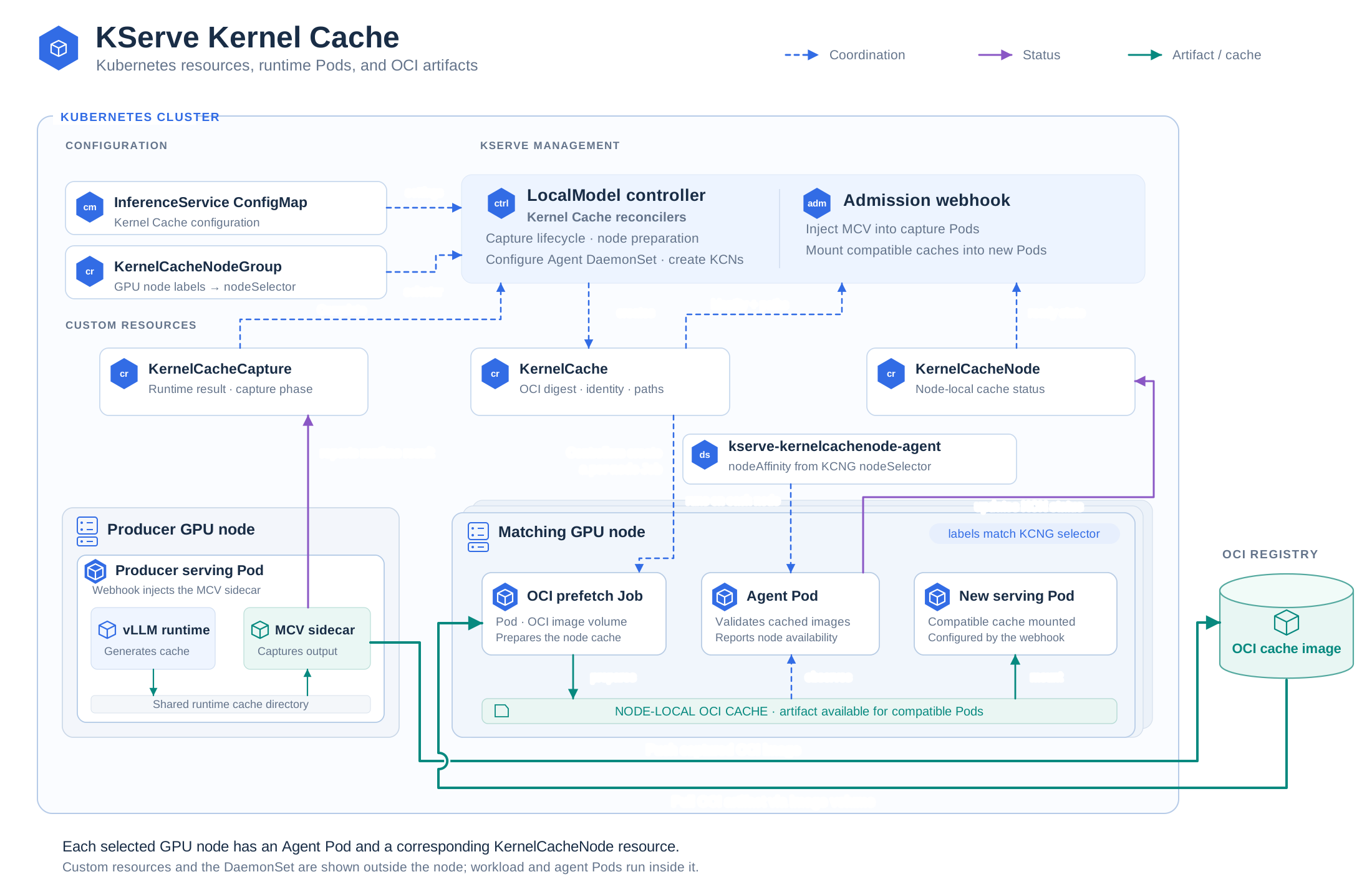
The architecture has four cooperating paths:
- Configuration and node setup: The Kernel Cache configuration enables the controllers and webhook. A
KernelCacheNodeGroupselects target nodes. The node controller derives Agent DaemonSet affinity from the selector and creates aKernelCacheNodefor each matching node. The Agent Pod validates node-local cache state and reports it through theKernelCacheNode. - Capture: When a producer Pod has no compatible prepared cache and sidecar injection is enabled, the admission webhook injects the MCV capture sidecar. MCV observes the runtime-generated cache, pushes an OCI image to the configured registry, and reports the runtime result to
KernelCacheCapture. - Artifact preparation: After a capture completes, the controller validates the reported artifact and creates a
KernelCachecontaining the immutable OCI reference, cache paths, identity, and target node group. The controller creates an OCI prefetch Job for each ready node in that group. The Job causes the node to pull the OCI image, and the node agent reports the resulting preparation state. Optionally, KServe can also prefetch the workload runtime image on those nodes. Runtime image prefetch warms the container image cache for later workloads; it does not affect Kernel Cache selection or artifact preparation. - Cache reuse: For a new serving Pod, the admission webhook compares the Pod identity and cache paths with the
KernelCachecandidates and checks the node-local readiness reported byKernelCacheNode. When a compatible cache is ready, it adds the OCI image volume, init container, and read-only cache mounts to the Pod.
Environment setup
KernelCacheNodeGroup and KernelCacheNode establish the node environment that can prepare and serve Kernel Cache artifacts:
Node group and agent topology
KernelCacheNodeGroup selects the nodes where the agent runs. The controller creates an Agent DaemonSet with node affinity derived from the selector, and each Agent Pod reports the local state through its KernelCacheNode object:
The node controller and agent maintain KernelCacheNode objects for the configured environment. The capture and cache controllers own the artifact lifecycle and its status. The admission webhook only selects a cache when the workload identity, artifact paths, namespace, and node preparation state are compatible.
Artifact and delivery model
The current API uses OCI delivery. A KernelCache artifact contains:
- An immutable image reference in the form
registry/repository@sha256:<digest>. - One or more cache paths.
- Identity factors and compatibility footprints used during selection.
Kernel Cache currently supports OCI image artifacts only. KernelCache.spec.artifact is immutable after the resource is created. KernelCache.spec.mountType is optional and defaults to oci; oci is currently the only accepted value.
The node group selects nodes and supplies tolerations used by the node agent and controller-managed preparation workloads. The node agent maintains node-local cache state, while OCI artifacts provide the cache contents.
Runtime image prefetch
Runtime image prefetch is an optional startup optimization. After a Kernel Cache capture completes, KServe can pull the captured workload's runtime image onto each selected cache node. Later workloads can use the node's container image cache instead of waiting for that image to be pulled when their Pods start.
This is separate from OCI artifact prefetch. OCI artifact prefetch prepares the Kernel Cache artifact for cache reuse. Runtime image prefetch prepares the workload container image only. It does not select a cache, download model weights, or change kernel compilation and reuse behavior.
KServe skips floating runtime image references, including :latest and untagged images. Use a versioned tag or digest when enabling runtime image prefetch.
Relationship to model serving
Kernel Cache is integrated with KServe model serving through the workload Pod and its runtime container. The identity includes the workload, model source hash, runtime image, runtime command and arguments, and supported runtime configuration factors. The webhook uses these values to distinguish an exact workload match from a compatible cache match.
The current capture API accepts only InferenceService as the sourceRef kind. The current model-source resolver also supports the InferenceService path for automatic cache selection and capture. Do not assume that an LLMInferenceService Pod is supported just because the webhook has identity labels for that workload kind.
For a selected cache, the admission webhook adds an OCI image volume, an init container that materializes the artifact into the runtime cache paths, and read-only source mounts. This happens only after the node-local cache entry is ready and the identity and path checks succeed.